
Should This Be a Business—or Just a Great Idea?

Some ideas are exciting because they have real business potential.
Others are exciting because they are creative, meaningful, fun, or personally interesting.
Those are not always the same thing.
One of the most useful skills an entrepreneur can develop is learning how to tell the difference.
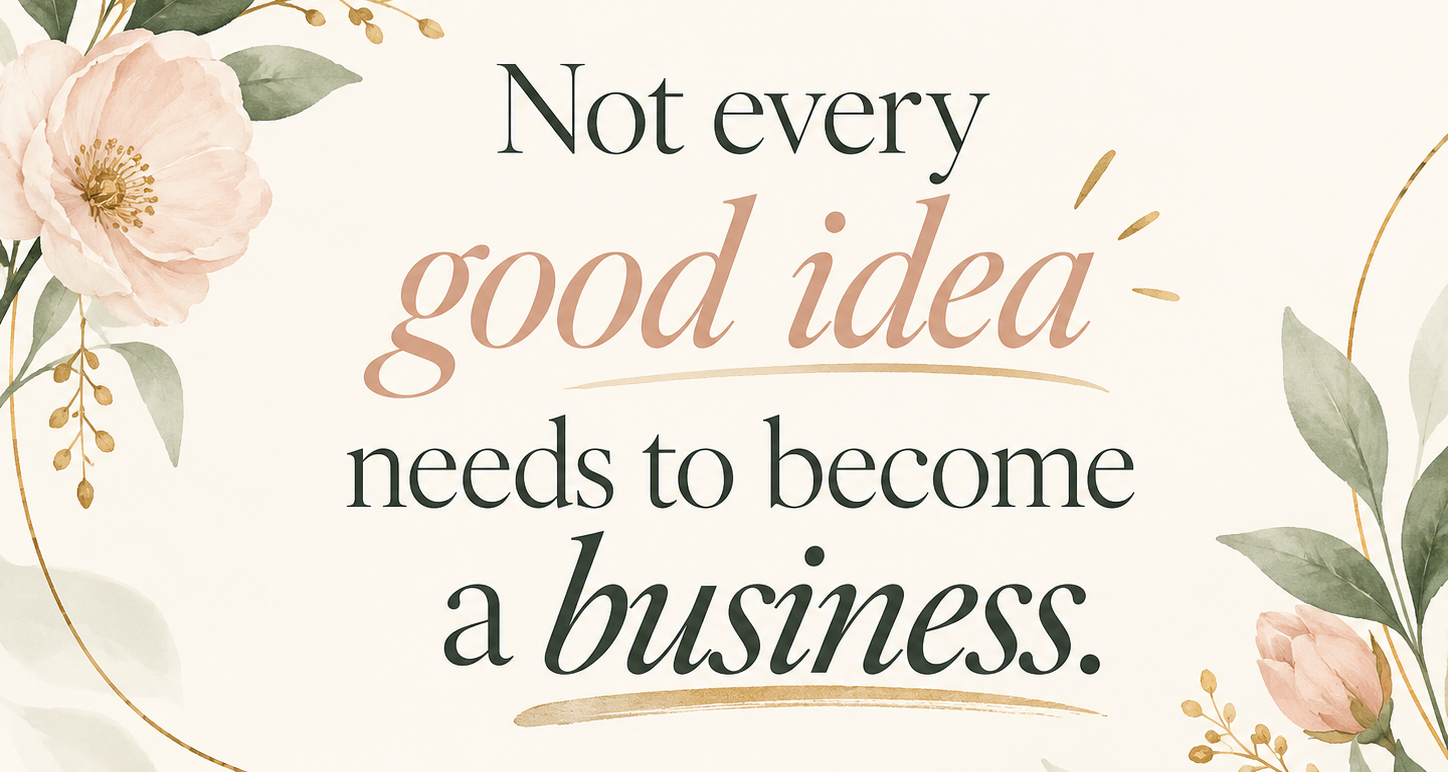
Because not every good idea needs to become a business.
And not every idea that could make money is a business you actually want to own.
Before you build the website, form the LLC, buy inventory, or start telling everyone about your new venture, it is worth asking a more personal question:
Should this actually become a business?
Start With the Obvious Question: Is There a Real Opportunity?
A good idea becomes more interesting when there is a clear problem, a specific customer, and a reason someone would pay for the solution.
Ask:
Who is this for?
What problem does it solve?
How are people solving that problem today?
Is the problem important enough to spend money on?
Is there already evidence that customers buy something similar?
If you cannot answer those questions yet, that does not mean the idea is bad.
It may simply mean it is still an idea.
And that is okay.
Do You Want the Business That Comes With the Idea?
This is where people sometimes get caught.
You may love the product.
But do you want to manage inventory?
You may love teaching.
But do you want to market a course every month?
You may love the idea of opening a beautiful studio.
But do you want to manage leases, employees, scheduling, payroll, and customer service?
You may have an innovative technology idea.
But do you want to spend years fundraising, hiring developers, and building a company around it?
The business is not just the thing you sell.
It is everything required to deliver it.
So ask yourself:
Do I want the day-to-day reality of this business—or do I just love the idea?
Does It Fit the Life You Want?
A business can be financially successful and still be the wrong business for you.
Some businesses require:
nights and weekends
frequent travel
constant customer interaction
large teams
significant capital
inventory
physical locations
high levels of risk
Others can be more flexible.
There is no universally “better” model.
But there is a better model for you.
Think about what you are actually trying to create.
More income?
More autonomy?
A creative outlet?
A path away from your current work?
An asset you could eventually sell?
Something your family could participate in?
A company you want to build for the next 15 years?
The answer matters.
Be Honest About Your Appetite for Risk
Every business has risk.
But some require much larger bets than others.
There is a big difference between testing a consulting service for a few hundred dollars and investing six figures in a physical location.
Before moving forward, understand what you are being asked to risk.
That might include:
money
time
reputation
career stability
family time
existing income
personal energy
Then ask:
If this does not work, am I comfortable with what I could lose?
You do not need to be fearless.
You just need to understand the bet you are making.
Does the Business Have Enough Financial Potential?
Passion matters.
But if you want this to be a business, the economics matter too.
Ask yourself:
What could I realistically charge?
What will it cost to deliver?
How many customers would I need?
How much time will it require?
What fixed expenses will I have?
Is there enough margin to make the effort worthwhile?
You do not need a perfect forecast.
You just need to understand whether the basic math has a chance of working.
Sometimes this exercise confirms the opportunity.
Sometimes it reveals that the idea would make a better hobby, side project, nonprofit initiative, or occasional service.
That is valuable information.
Does It Depend Entirely on You?
There is nothing wrong with building a business around your expertise.
Many great businesses start that way.
But understand what you are creating.
If the company only generates revenue when you personally work, your growth will eventually be limited by your time.
Ask:
If demand doubled, what would happen?
Could you hire?
Create systems?
Use technology?
Train someone else?
Productize part of the service?
Increase pricing?
Or would you simply have to work twice as much?
Again, neither answer is automatically wrong.
You just want to know what kind of business you are choosing.
Are You Excited About Selling It?
This one matters more than many first-time entrepreneurs realize.
You can build an incredible product or service.
But people still have to know it exists.
That usually requires some combination of:
conversations
networking
marketing
content
partnerships
sales
follow-up
If the thought of telling people about the business makes you deeply uncomfortable, do not ignore that.
You do not have to become a stereotypical salesperson.
But every entrepreneur needs some willingness to communicate value and ask someone to buy.
Would You Still Want It If Nobody Thought It Was Impressive?
Sometimes the idea of being an entrepreneur can be more exciting than entrepreneurship itself.
Launching something new feels exciting.
Having a brand feels exciting.
Being introduced as a founder feels exciting.
But businesses are built in the much less glamorous moments.
Answering emails.
Fixing mistakes.
Reviewing numbers.
Following up.
Making payroll.
Changing plans.
Solving the same problem repeatedly until the system gets better.
A useful question is:
Would I still want to build this if nobody thought it was impressive?
If the answer is yes, pay attention.
Could This Stay Small—and Still Be Worth It?
Not every business needs to scale into something enormous.
A small business can be extremely successful if it creates:
meaningful income
flexibility
autonomy
interesting work
financial security
a lifestyle you enjoy
Sometimes entrepreneurs dismiss good opportunities because they are not “big enough.”
But the right question is not:
How big could this become?
It is:
Could this become valuable enough to accomplish what I want?
That definition will be different for everyone.
Maybe the Answer Is “Not Yet”
You do not have to decide immediately.
Sometimes an idea needs more research.
More customer conversations.
A smaller test.
A different business model.
A better understanding of the economics.
Or simply better timing.
“Not yet” is a legitimate business decision.
So is “no.”
Protecting your time and capital from the wrong opportunity gives you more ability to pursue the right one later.
Before You Turn the Idea Into a Business
Ask yourself:
Is there a real customer problem?
Will people pay to solve it?
Can the economics work?
Do I want the day-to-day reality of this business?
Does it fit the life I want?
Am I comfortable with the risk?
Am I willing to sell it?
Can it grow in a way that makes sense?
Would it still be worth building if it stayed relatively small?
And perhaps most importantly:
Why do I want to build it?
There is nothing wrong with having big ideas.
There is nothing wrong with deciding some of them should remain ideas, either.
Entrepreneurship is not about turning every possibility into a company.
It is about learning which opportunities are worth your time, money, energy, and attention.
FoundHER MD exists to help women physicians and entrepreneurs explore those opportunities thoughtfully—so the businesses they choose to build are businesses they actually want to own.
